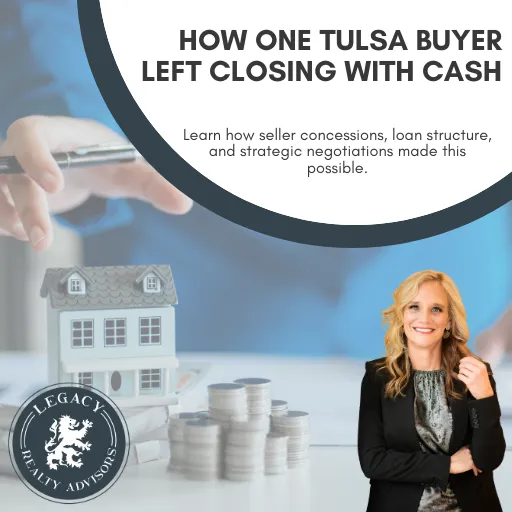
How One Tulsa Buyer Left Closing With Cash
How One Tulsa Buyer Left Closing With Cash
Most buyers walk into closing expecting to write checks. They have budgeted for the down payment, set aside money for closing costs, and mentally prepared to hand over a significant amount of money before they get the keys. What they do not expect is to walk out with money in their pocket.
That is exactly what happened on May 2nd when my buyer closed on her first home in Midtown Tulsa.
She got in with zero down. She received a brand new $12,000 roof. And she got her earnest money back at closing. The check she brought in came back to her. I want to walk through how each of those things happened, because none of it was accidental, and all of it is replicable for the right buyer in the right situation with the right Real Estate advocate and the right Lender.
The Role of Seller Concessions in Getting Money Back at Closing
Seller concessions are the mechanism that makes this possible. A seller concession is when the seller agrees to contribute a percentage of the purchase price toward the buyer's closing costs, prepaid items, and other allowable expenses. When those contributions cover more than the buyer owes at the table, the buyer's out-of-pocket drops to zero, and any overage from earnest money already deposited comes back to them as a credit.
That is not a glitch in the system. That is the system working exactly as designed.
In this transaction, I negotiated the seller to pay my buyer's closing costs as part of the purchase agreement. Chuck Wilson at AMC Mortgage, who has been in the finance business for nearly 30 years, structured the loan so that the maximum allowable seller concessions were available to her. That piece matters more than most buyers realize. The loan type you choose determines how much the seller is actually allowed to contribute, and if you choose the wrong loan for your situation, you may be leaving money on the table before negotiations even begin.
Chuck can tell you in a single conversation which loan type gives you the most flexibility for seller concessions based on your credit, your income, and the price range you are shopping in. That conversation is worth having before you ever write an offer.
How the Earnest Money Came Back
When my buyer went under contract, she put up earnest money, which is the good-faith deposit a buyer submits when an offer is accepted. It signals to the seller that you are serious, and it is held in escrow until closing.
At the closing table, all the numbers come together. The purchase price, the loan amount, the seller concessions, the credits, the fees. When Chuck structured this loan and I negotiated the seller contribution, the credits applied at closing covered her costs so completely that the earnest money she had already deposited was returned to her.
She brought a check to closing and left with it.
For a first-time buyer who stretched to pull that deposit together in the first place, getting it back is not a small thing. It means she closed on a home and still had that money available to her on the other side. Moving expenses. First month of utilities. A little breathing room. That matters enormously when you are just getting started.
The $12,000 Roof She Also Walked Away With
Here is the part of this story that still makes me smile.
During the inspection, the roof came back in bad shape. In a transaction like this, that kind of finding can derail everything. Some buyers panic. Some sellers dig in. What you do with an inspection report is one of the most important negotiations in the entire process, and it is one that a lot of buyers do not realize they have real leverage in.

I negotiated a brand new roof as part of the repair agreement. Twelve thousand dollars. Installed before closing.
She did not just buy a house. She bought a house with a new roof, zero out of pocket, and her earnest money returned. That is what happens when the right loan is structured correctly, the negotiations are handled strategically, and the team around the buyer knows what they are doing.
What Buyers Need to Understand About Loan Type and Seller Concessions
Chuck makes this point clearly, and it is worth repeating here. The loan type you choose determines the maximum seller concessions you are allowed to receive. This is not a minor detail. It is a structural decision that affects how much help you can negotiate from the seller before you ever sit down to make an offer.
FHA loans, conventional loans, VA loans, and USDA loans all have different caps on seller concessions, and those caps can vary further based on your down payment percentage. Choosing the wrong loan for your situation can limit what the seller is allowed to contribute, even if the seller is willing to give more.
This is exactly why talking to Chuck before you start shopping is so important. He is not just running your credit and issuing a pre-approval letter. He is helping you understand which loan structure gives you the most flexibility, the most buying power, and the best shot at a closing that looks like this one.
Nearly 30 years in this business means Chuck has seen every version of this conversation, and he knows how to match the right loan to the right buyer so that when you get to the negotiating table, nothing is being left behind.
What Sellers Should Know About This Too
If you are selling a home in the under-$250,000 range in Tulsa, this story is relevant to you as well.
A seller who is willing to contribute toward closing costs is not giving money away. They are opening their home to a significantly larger pool of qualified buyers, many of whom are ready to close quickly and cleanly. This buyer closed in 30 days. She was motivated, prepared, and working with a loan officer who knew how to move.
When you market your home with seller contributions built into the strategy, you are not discounting your property. You are removing the barrier that is keeping the most active segment of buyers in your price range from making an offer. That is a positioning decision, and in the right market at the right price point, it sells homes faster than almost anything else.
FAQ: Getting Money Back at Closing in Tulsa
Can any buyer get money back at closing?
Getting money back at closing depends on how the loan is structured and how much the seller contributes.
When seller concessions cover all of a buyer's allowable closing costs and prepaid items, any earnest money already held in escrow can be returned at closing rather than applied to fees. This does not happen automatically. It requires the right loan type, the right negotiation, and a lender who structures the file correctly from the beginning. Chuck Wilson at AMC Mortgage is who I trust to do that.
How much can a seller contribute toward closing costs?
The maximum seller contribution depends entirely on the loan type and the buyer's down payment.
FHA loans, conventional loans, VA loans, and USDA loans each have different caps. On some loan types, a seller can contribute up to 6 percent of the purchase price. On others, the limit is lower. This is one of the most important reasons to talk to your lender before you write an offer, so you know exactly how much flexibility you have going into negotiations.
Does the type of loan really make that big a difference?
Yes. The loan type is one of the most consequential decisions a buyer makes in the entire process.
It affects your interest rate, your monthly payment, your mortgage insurance requirements, and the maximum seller concessions you are allowed to receive. Two buyers with identical credit scores and income can end up in very different positions at the closing table depending on which loan they chose. Chuck Wilson can walk you through the options specific to your situation so you are choosing from a position of information, not guesswork.
Is it common for buyers to negotiate a new roof in addition to seller concessions?
It is not automatic, but it is absolutely possible when the inspection supports it and the negotiation is handled well.
An inspection report is a negotiating document. When a significant defect comes back, buyers have real leverage to request repairs, credits, or price reductions. In this transaction, the roof came back in poor condition and I negotiated a full replacement before closing. The seller agreed because the alternative was losing a clean, motivated, pre-approved buyer. Knowing when to push and how to frame the request is what 25 years of experience gives you.
3-2-1 Takeaway
3 Things to Remember
The loan type you choose before you start shopping determines how much the seller is allowed to contribute toward your closing costs. That decision has a direct impact on how much money you bring to the closing table, and Chuck Wilson at AMC Mortgage can help you choose correctly.
Seller concessions are a legitimate and powerful negotiating tool. When structured right, they can bring a buyer's out-of-pocket to zero and return their earnest money at closing, exactly as happened in this Midtown Tulsa transaction.
The inspection report is not the end of the negotiation. It is the beginning of a new one. A $12,000 roof replacement was secured for this buyer because the findings were handled strategically and with confidence.
2 Questions Worth Asking
Which loan type gives me the most flexibility for seller concessions in the price range I am shopping, and what does that mean for my out-of-pocket at closing?
If something significant comes back in the inspection, what is my leverage, and how do I use it without losing the deal?
1 Thing to Do Next
If you are thinking about buying a home in Tulsa, start with the loan conversation before you start the home search. Understanding your loan options changes everything about how you negotiate, what you ask for, and what you walk away with at closing. Book a time with me at https://link.cncsdirect.com/widget/booking/2BPftOW1aYttaxdttERz and we will make sure you are set up to close like this buyer did.
Jennifer Mount is a licensed REALTOR and Managing Broker at Legacy Realty Advisors in Tulsa, Oklahoma. Loan program details, contribution limits, and concession caps are subject to change and vary by loan type. Contact a licensed mortgage professional for guidance specific to your situation. Chuck Wilson, AMC Mortgage.


