
How to File Your Homestead Exemption in Tulsa County, Oklahoma
How to File Your Homestead Exemption in Tulsa County, Oklahoma

Filing for a homestead exemption in Tulsa County requires submitting an application to the Tulsa County Assessor by March 15 or within 30 days of receiving a property valuation increase notice. Homestead exemption reduces a home's assessed valuation by $1,000, saving homeowners money annually depending on their specific location within the county.
What is the Oklahoma Homestead Exemption?
The Oklahoma homestead exemption reduces the assessed valuation of a primary residence by $1,000. This deduction directly lowers the annual property tax bill for qualifying homeowners. According to the Tulsa County Assessor, the exemption saved homeowners money during the 2019 tax year, with the exact amount varying by location within the county.
Homeowners in Tulsa county and Wagoner county who meet the eligibility criteria can self file with county assessor offices to claim this benefit. The process requires specific documentation and adherence to statutory deadlines. Missing the filing window means losing that year’s savings entirely.
Who qualifies for the homestead exemption in Oklahoma?
Three conditions must be met. The applicant must be the homeowner of record who resides on the property as of January 1. The property deed requires notarization on or before that date. The applicant must also be a resident of Oklahoma.
How does the $1,000 exemption actually lower a tax bill?
The exemption subtracts $1,000 from the property’s assessed value, not its market value. County assessors calculate taxes based on a percentage of assessed value. A lower assessed value produces a lower tax obligation. The Tulsa County Assessor confirms this mechanism generated real dollar savings, depending on the specific taxing district where the home sits.
Who qualifies and what are the key deadlines?
Qualifying for the homestead exemption in Tulsa county hinges on two firm requirements. The applicant must be the homeowner of record who resides on the property by January 1. The property must serve as the owner's primary residence.
Meeting the ownership deadline demands careful timing. The property deed requires notarization on or before January 1. Filing with the County Clerk's Office must happen on or before February 1. Missing either cutoff delays eligibility.
What is the final deadline to file for the current tax year?
Applications must reach the assessor no later than March 15 to take effect for the current year. A second trigger exists for those who receive a Notice of Increase in Valuation. The filing window extends to 30 days from the mailing date printed on that notice. Homeowners who miss both windows lose the exemption for that tax cycle.
Can a homeowner file after March 15?
Self file with county assessor offices remains possible year-round. Applications are accepted at any time throughout the year. A late filing simply applies to the following tax year rather than the current one. This flexibility helps new buyers who close after the spring deadline.
The process follows a clear sequence:
Confirm the deed is notarized by January 1 and recorded by February 1.
Establish primary residency at the property by January 1.
Submit the application by March 15 for immediate tax relief.
File after March 15 to secure the exemption for the next tax year.
Wagoner county residents follow similar qualification rules, though deadline dates may vary slightly by jurisdiction. Tulsa county homeowners who act before March 15 lock in savings that reduce the assessed valuation by $1,000. Delaying past the deadline shifts that benefit an entire year forward.
How do I file my homestead exemption in Tulsa County?
Filing a homestead exemption in Tulsa County reduces the assessed valuation of a primary residence by $1,000. Homeowners can self file with county assessor offices through four distinct methods. The process protects a portion of home value from taxation, delivering annual savings that compound over time.
What form is required for the Tulsa County homestead exemption?
The official document is the Application for Homestead Exemption, designated as OTC 921 for tax years 2027–2028. This state form collects detailed property and ownership information. The Oklahoma Tax Commission provides the form, and the Tulsa County Assessor's office processes completed applications.
What information must the application include?
The OTC 921 form requires several specific data points. Homeowners must supply their full name, account number, telephone number, and email address. The property address and mailing address both appear on the form. A complete legal description of the property and the applicable school district are mandatory fields. The form also asks whether the applicant is a legal resident of Oklahoma.
Step-by-step filing instructions
Follow these numbered steps to complete the homestead exemption application:
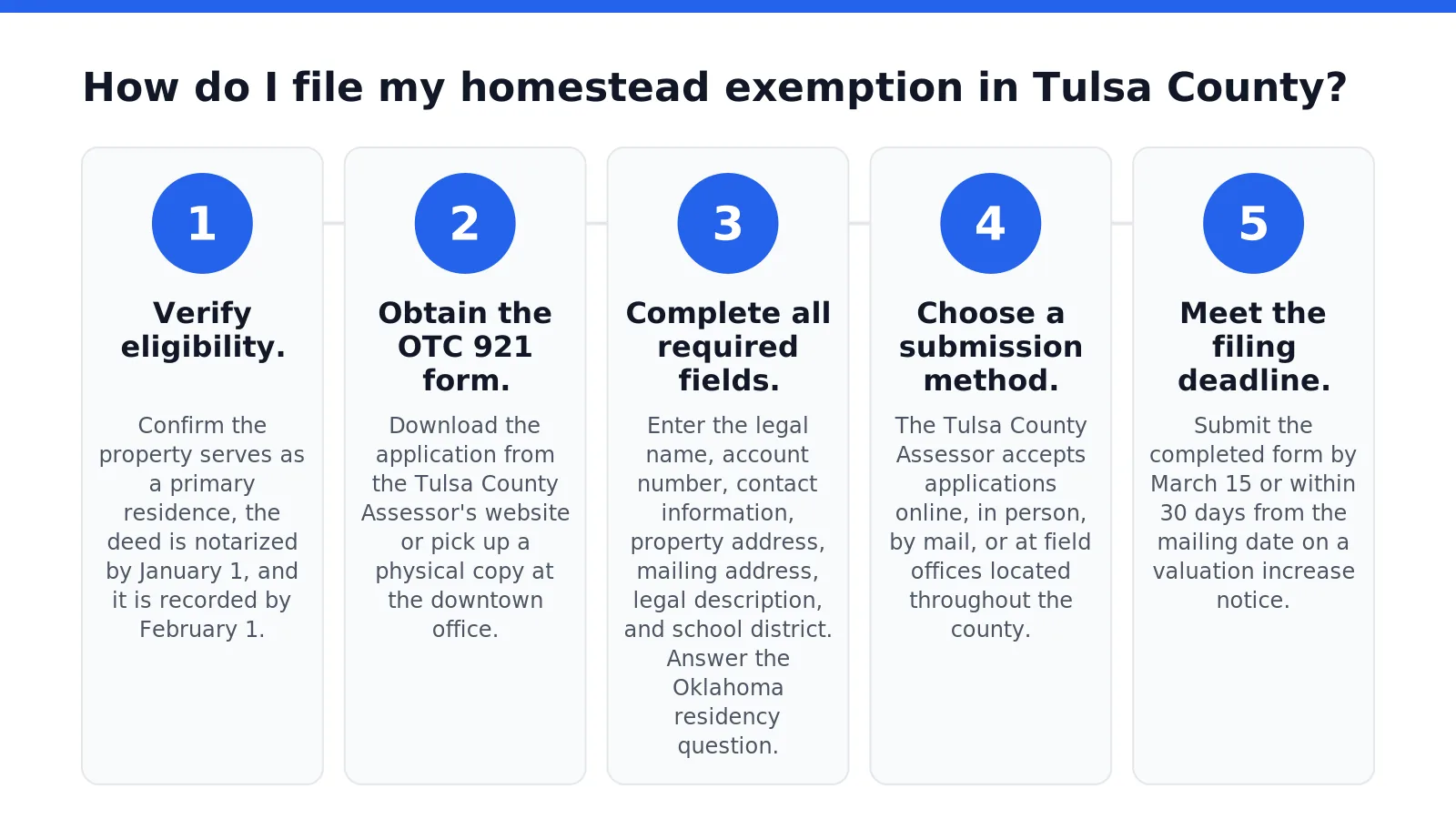
Verify eligibility. Confirm the property serves as a primary residence, the deed is notarized by January 1, and it is recorded by February 1.
Obtain the OTC 921 form. Download the application from the Tulsa County Assessor's website or pick up a physical copy at the downtown office.
Complete all required fields. Enter the legal name, account number, contact information, property address, mailing address, legal description, and school district. Answer the Oklahoma residency question.
Choose a submission method. The Tulsa County Assessor accepts applications online, in person, by mail, or at field offices located throughout the county.
Meet the filing deadline. Submit the completed form by March 15 or within 30 days from the mailing date on a valuation increase notice.
Where can homeowners submit the application?
Four submission channels exist for Tulsa County residents. The online portal offers the fastest processing. In-person filing occurs at the Tulsa County Assessor's downtown office. Mail submissions go directly to the assessor's mailing address. Field offices provide convenient drop-off points for homeowners in outlying areas of the county.
Missing the deadline forfeits the exemption for that tax year. The savings vary annually depending on the specific taxing district within Tulsa County. Homeowners who file correctly lock in reduced property taxes year after year without reapplying.
What documents do I need before starting Form 921?
Gathering the right paperwork before completing Form 921 prevents processing delays and protects a homeowner's eligibility for the homestead exemption. The Tulsa County Assessor requires specific documentation proving ownership, residency, and identity. Missing even one item risks losing the exemption for that tax year.
What proves the property is my primary residence?
Three core documents establish that a home qualifies as a primary residence in Tulsa county. First, the property deed must be notarized on or before January 1 and filed with the County Clerk's Office on or before February 1. Second, the homeowner must be the owner of record residing on the property by January 1. Third, the applicant must be a resident of Oklahoma. These requirements work together to confirm the property serves as the owner's main home rather than an investment or secondary dwelling.
What personal information does Form 921 require?
The form itself demands several specific details pulled directly from supporting documents. Applicants need their full legal name, account number, telephone number, and email address. The property address and mailing address must match county records. A complete legal description of the property and the correct school district are also mandatory fields on the form. Having a recent tax statement or deed handy makes filling out these sections straightforward.
Can I file the homestead exemption myself?
Homeowners can self file with county assessor offices without hiring a third party. The Tulsa County Assessor accepts applications online, in person, by mail, or at field offices. The same process applies in neighboring Wagoner county for properties located there. Filing independently saves money and gives owners direct control over their application timeline. The key deadline remains March 15, or within 30 days from the mailing date on a valuation increase notice.
What common mistakes should I avoid when filing?
Filing errors delay the homestead exemption and cost homeowners real money. A missed deadline or incorrect paperwork means paying the full tax bill on a primary residence for an entire year. The Tulsa County Assessor rejects applications that fail to meet three specific legal requirements.
What is the most common deadline mistake?
Homeowners often assume the application window stays open indefinitely. The Tulsa County Assessor requires applications no later than March 15 to be effective for the current tax year. A second deadline applies when a property receives a Notice of Increase in Valuation. In that case, the application must arrive within 30 days from the mailing date indicated on that notice. Missing either cutoff forfeits the exemption until the following year.
What ownership requirements cause denials?
Purchasing a home in February disqualifies the owner for that tax year. The property deed carries its own timeline. The deed must be notarized on or before January 1 and filed with the County Clerk's Office on or before February 1. A deed signed after January 1 or recorded after February 1 invalidates the application.
How do filing method errors happen?
Some homeowners submit incomplete forms or use the wrong channel. The Tulsa County Assessor accepts applications online, in person, by mail, and at field offices. Calling (918) 596-5100 allows a homeowner to request a protest form by mail if a valuation dispute arises. The safest approach for a new Tulsa county resident involves confirming deed recording dates before starting the application. Wagoner county residents follow a separate process with their own assessor's office. Verifying the correct county jurisdiction prevents a rejected filing.
Conclusion
Filing the homestead exemption in Tulsa County comes down to three things: owning the home, living in it by January 1, and getting that form in by March 15. Gather your deed and tax statement before starting the application, then submit through the online portal or drop it off at the assessor's office. A few minutes of paperwork now locks in years of savings on your primary residence.