The Real Cost to Sell Your Home in 2026 (It's Not What You Think)
The Real Cost to Sell Your Home in 2026 (It's Not What You Think)
With St. Patrick's Day around the corner, let me ask you something.
Is selling your house about luck?
I get why people think that. The right buyer shows up at the right time. The market cooperates. Everything just... works out.
But here's what I've learned after 24 years in real estate: homes that sell smoothly and profitably aren't lucky.
They're positioned.
As the managing broker of Legacy Realty Advisors in Tulsa, I can tell you with confidence that 99% of a successful home sale is strategy. There's maybe 1% luck involved in timing.
If you're preparing to sell your house in 2026, here's what it really costs and where strategy protects your net proceeds.
What Does It Cost to Sell a House?
When sellers Google "cost to sell a house," they usually think commission.
But that's only part of the picture.
Here are the core cost categories you need to understand.
1. Brokerage Fees
Commission structures vary and are negotiated before listing.
But here's what most sellers misunderstand: the difference between a full-service brokerage and a reduced-service model is more than just percentage points.
It's the scope of protection, representation, effort, strategy, and professionalism you get.
According to recent industry surveys, average real estate commission rates nationally range from 5% to 6% of the home's sale price. In many markets, this breaks down to around 2.75% to 3% for the listing agent and 2.75% to 3% for the buyer's agent, though all commission rates are fully negotiable.
Commission covers:
Pricing strategy based on current market conditions
Professional marketing and digital exposure
Photography and video production
Negotiation expertise
Contract management and compliance
Risk mitigation throughout the transaction
The real question you should be asking is "What does the strategy return?" rather than just "What is the fee?"
A Behind-the-Scenes Reality Most Sellers Don't See
Recently, I represented buyers in two separate transactions where the seller had chosen a limited-service or discount brokerage model.
What that meant in practice was this: there was no listing agent actively managing the seller's side of the transaction.
Even though I represented the buyer, I was coordinating directly with the seller. That creates several challenges.
There's no professional buffer during negotiations. There's no experienced contract oversight on the listing side. Communication delays happen. Emotional tension increases. The risk of misunderstandings grows.
When a transaction lacks balanced professional representation, the workload doesn't disappear. It shifts.
And often, it shifts onto the buyer's agent.
That can create friction, slower timelines, and more stress for everyone involved.
It's about structure, having experienced professionals on both sides guiding pricing strategy, inspection negotiations, appraisal discussions, contingency timelines, and contract compliance. That balance protects the transaction and maximizes everyone's experience.
2. Seller Closing Costs
According to Zillow's research on seller closing costs, average closing costs for sellers have historically ranged from 8% to 10% of the home's sale price when you include both agent commission and seller fees (https://www.zillow.com/learn/closing-costs-for-sellers/).
Beyond commission, sellers should plan for closing costs that typically range between 1% and 3% of the sale price, depending on your location and transaction details.
These costs include:
Title fees and title insurance
Owner's title policy (protects the buyer)
Prorated property taxes for the portion of the year you owned the home
HOA transfer fees (if applicable)
Recording fees to legally record the deed
Settlement or escrow fees
These costs vary by state. For example, transfer taxes alone can range from 0.1% in some states to over 0.4% in others.
Every seller should receive a customized net sheet before listing so you know exactly what you'll walk away with.
3. Preparation and Staging Costs
In today's market, preparation matters more than ever.
Buyers in 2026 are cautious and payment-sensitive. With mortgage rates that recently dropped below 6% for the first time since 2022, buyers are active again but they're careful about where they commit their money.
That means expectations are higher.
Small strategic investments often prevent large price reductions later.
We frequently recommend professional staging through Shelly K Staging and lawn preparation with Lawn Republic.
According to the National Association of Realtors, 97% of home buyers start their search online. Your listing photos are the first impression, and professional photography can cut time on market by 20% to 30%.
Strategic improvements often increase perceived value more than their cost. Fresh paint, updated light fixtures, professional staging, and strong curb appeal can make the difference between sitting on the market and generating multiple offers.
A Real Seller Conversation
I recently met with a homeowner who was focused almost entirely on commission savings.
They were considering a reduced-service model to save approximately 1% in fees.
When we ran the numbers together, something interesting happened.
The pricing strategy they were considering to "move it quickly" would likely have cost them significantly more in net proceeds than the commission savings.
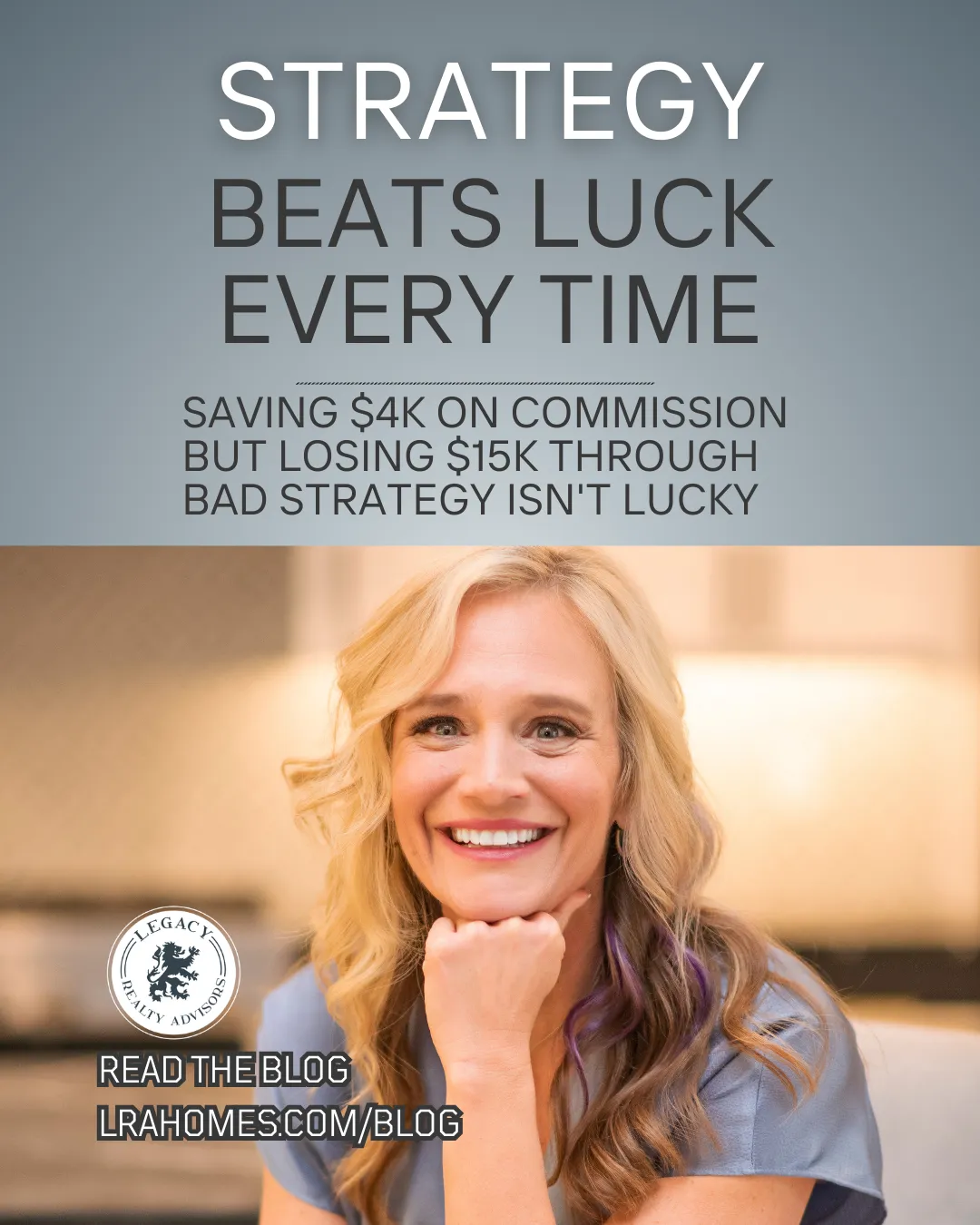
In other words, they were trying to save $4,000 in commission but risked losing $10,000 or more in positioning and negotiating leverage.
Selling your home is maximizing net proceeds, paying the lowest fee.
Here's the math on their specific situation:
Reduced-service scenario:
Save 1% on commission: $4,000
Price 3% below optimal positioning to "move it fast": lose $12,000
Net result: −$8,000
Full-service scenario:
Pay full commission
Position correctly from day one
Negotiate from strength
Net result: $8,000 more in pocket
That's a $16,000 swing based purely on strategy.
4. The Hidden Cost of Sitting on the Market
If your home lingers, you continue paying:
Mortgage payments
Utilities (electric, gas, water)
Insurance premiums
Property taxes
Maintenance and upkeep
And often, you eventually reduce the price anyway.
According to Zillow data, sellers who accept an offer within the first week of listing have a 57% chance of selling for list price (https://www.zillow.com/learn/when-to-reduce-house-price/). During week two, it drops to 50%. Then 39%, then 32%, and it continues to decline from there.
Correct pricing at launch protects momentum. Momentum protects net proceeds.
Research shows that roughly two-thirds of homes that sell go under contract in 14 days or less. After that first two weeks, buyers start to wonder what's wrong with the property.
The cost of sitting extends beyond monthly expenses. It's opportunity cost, stress, and the eventual price reductions that could have been avoided with better positioning from day one.
The 5 Fs of Selling Your Home
Selling your home touches every part of your life, and the right strategy protects more than just your wallet.
Faith: Stewardship means protecting your largest asset wisely. Making smart decisions about how you sell honors the equity you've built.
Family: Clarity reduces stress during transitions. When you know your numbers and have a solid strategy, the whole family feels more secure.
Finances: Net proceeds matter more than list price. It's what you walk away with that funds your next chapter.
Fitness: Financial confidence reduces anxiety. Knowing you're positioned well lets you sleep better at night.
Fun: Strong equity unlocks your next chapter. Whether you're upsizing, downsizing, or relocating, maximizing your net gives you more options.
Why Strategy Beats Luck Every Time
There's a little bit of luck involved in timing, sure.
But 99% of a successful home sale is strategy.
Strategy means:
Pricing based on the last 60 days of market data
Positioning your home to capture the critical first 14-day window
Professional marketing that reaches qualified buyers
Expert negotiation that protects your interests
Contract management that prevents issues before they become problems
At Legacy Realty Advisors, we specialize in maximizing net proceeds while protecting your timeline.
We serve Tulsa, Bixby, Jenks, Broken Arrow, and surrounding communities with one goal: get you the most money possible with the least amount of stress.
3-2-1 Seller Takeaway
3 Things You Learned
Commission is only one part of selling costs. According to Zillow, average closing costs for sellers range from 8% to 10% of the sale price when you include commission and fees. Understanding the full picture helps you make better decisions.
Pricing strategy impacts net proceeds more than percentage savings. Trying to save 1% on commission while pricing 3% below optimal positioning costs you money. The first week on market matters most—sellers who accept offers in week one have a 57% chance of getting list price.
Preparation protects leverage in today's market. With 97% of buyers starting their search online, professional photography and staging can cut days on market by 20-30%. Small investments prevent large price reductions.
2 Things to Share
Selling is 99% strategy and only a little bit of luck. Homes that sell smoothly and profitably are positioned correctly from day one. Subscribe to our YouTube channel for more selling strategy.
Net proceeds matter more than headline sales price. What you actually walk away with after all costs is what funds your next move. Share this with anyone preparing to sell.
1 Thing to Implement
Request a customized seller net sheet before choosing your listing strategy. Book your consultation to see exactly what you'll net from your home sale.
Ready to Talk Strategy?
If you're preparing to sell your house, let's review:
Current market value based on recent sales
Estimated closing costs for your specific transaction
Loan payoff and equity position
Projected net proceeds with different pricing scenarios


