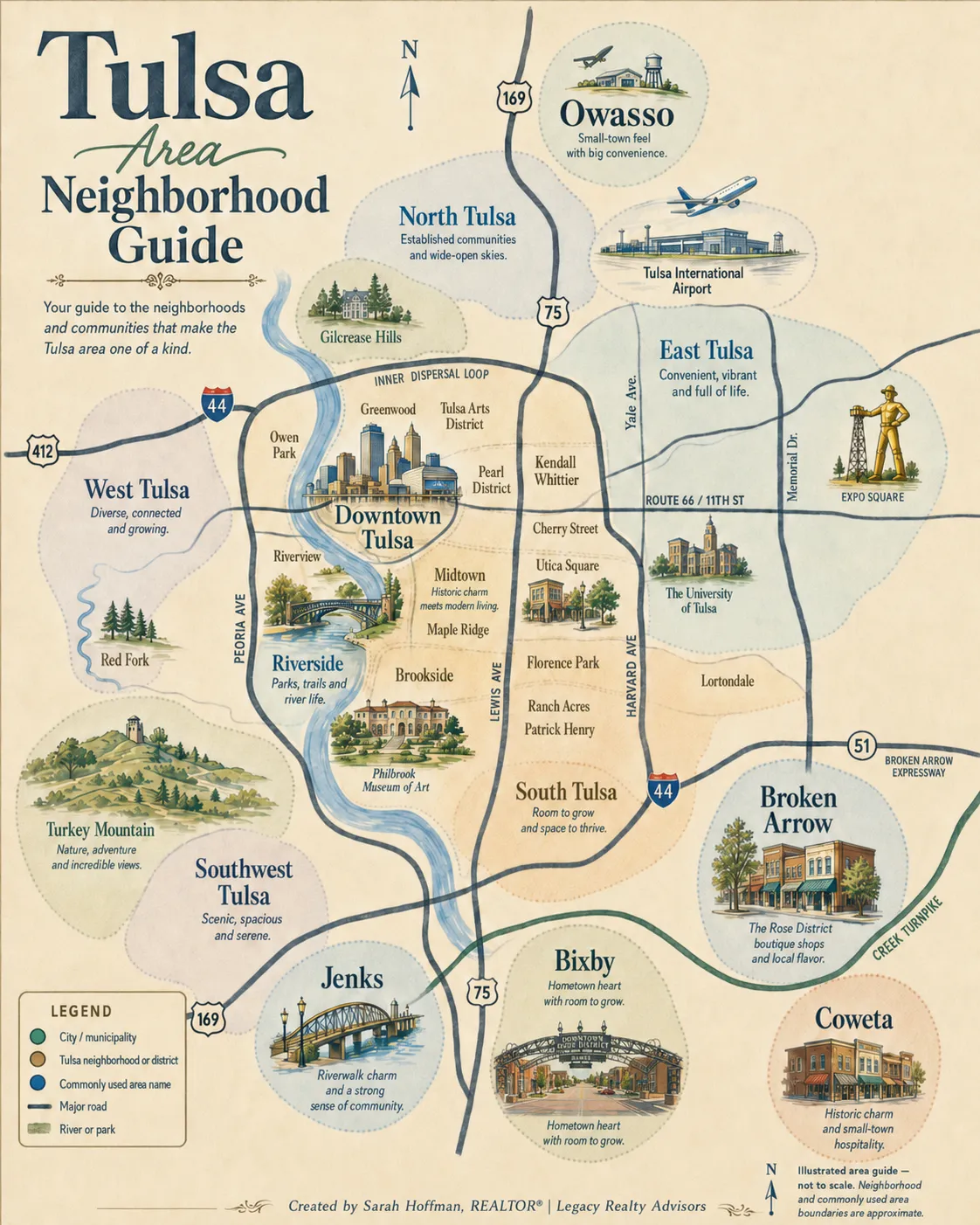
Tulsa Area Neighborhood Guide by Sarah Hoffman, REALTOR®
Tulsa Area Neighborhood Guide
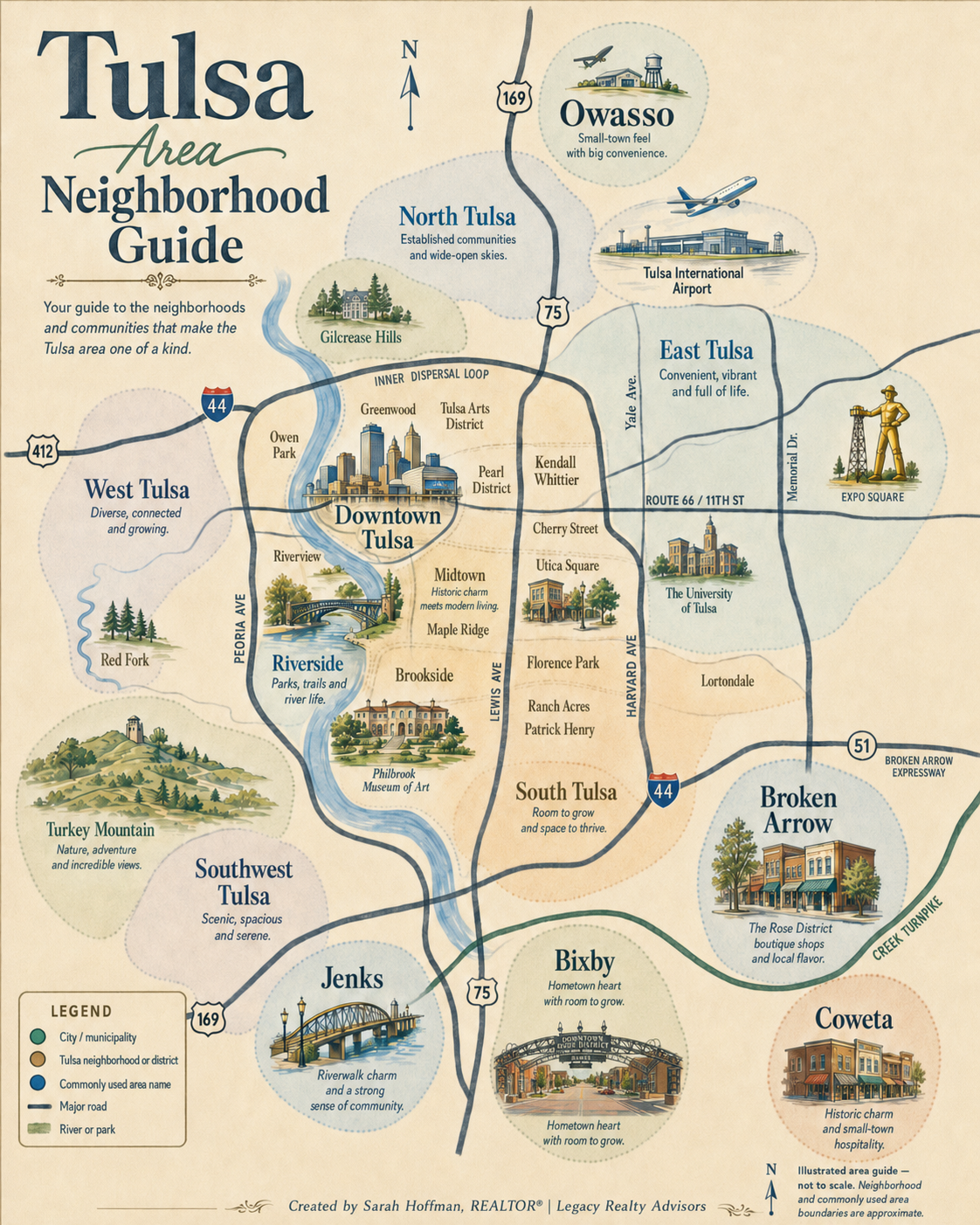
I put this guide together because I get the same question on repeat: where should I even start looking? Tulsa isn't one market. It's a collection of small ones, and the right fit depends on your commute, your budget, and how much yard you actually want to maintain. Use the map to get your bearings, then read through the areas below before you start touring.
Some buyers already know they want a walkable downtown loft. Others want acreage in Coweta and don't want to see a neighbor's porch light from their kitchen window. Most people land somewhere in between, which is exactly why this guide breaks Tulsa into its real submarkets instead of treating the metro like one giant area. Read through a few sections that catch your eye, then reach out and I'll pull actual listings for whichever ones fit.
Downtown Tulsa
Downtown is where the skyline meets the street-level energy of Greenwood, the Tulsa Arts District, Owen Park, the Pearl District, and Kendall Whittier. You'll find lofts, converted warehouses, and new construction mixed in with some of the city's most important history, including Greenwood Rising, which tells the story of the district's legacy. It's a walkable stretch built for people who want restaurants, galleries, and their morning coffee within a few blocks of home.
Midtown
Midtown covers a lot of ground, from Utica Square and Cherry Street to Maple Ridge, Brookside, Florence Park, Ranch Acres, and Patrick Henry. The homes here tend to be older and full of character, with mature trees lining the streets and the Philbrook Museum of Art tucked into the mix. It's the kind of area where you can walk to a coffee shop on Saturday morning and still have plenty of yard space at home.
Riverside
Riverside centers on Riverview and the stretch of parks and trails that follow the Arkansas River. If you like to run, bike, or just be near water, this is the part of town built around that. The river trail connects easily into Midtown, so you get access without giving up convenience.
North Tulsa
North Tulsa, including Gilcrease Hills, is one of the more established parts of the city, with wider lots and a slower pace than areas closer to downtown. The Gilcrease Museum sits nearby, and the area has held onto a lot of its original character over the years. It's a good fit if you want more space without leaving city limits.
East Tulsa
East Tulsa runs from Expo Square, home of the Golden Driller, out toward the University of Tulsa campus. It's one of the more convenient parts of town for getting around the metro, with quick access to Memorial Drive and Route 66. You'll find a mix of housing stock here, from older homes to newer builds.
South Tulsa
South Tulsa, near Lortondale, is where a lot of newer construction has gone in over the past couple of decades. Lot sizes tend to run larger here, with more room between neighbors than you'll find further north. It's a straightforward option if you want modern floor plans and easy freeway access.
West Tulsa
West Tulsa, including Red Fork, sits across the river from downtown and has been changing quickly. You'll find a mix of long-time residents and new development, with some of the more affordable entry points into the Tulsa market. Peoria Avenue runs right through it, connecting you back into the core of the city in minutes.
Southwest Tulsa
Southwest Tulsa is anchored by Turkey Mountain, which gives the area a different feel than the rest of the city. Trails, elevation, and tree cover make it a draw for anyone who wants nature close by without leaving the metro. Lots here tend to be more spread out, with some properties backing right up to the woods.
Owasso
Owasso sits just north of Tulsa near the airport and has grown into one of the more popular suburbs in the metro. It carries a small-town feel, with new subdivisions, shopping, and restaurants added steadily over the past several years. Highway 169 makes the commute into Tulsa an easy one.
Broken Arrow
Broken Arrow's Rose District is the heart of the city, with boutique shops, restaurants, and a walkable downtown that hosts events throughout the year. Outside the district, you'll find a wide range of subdivisions and newer construction spread across a large footprint. It's one of the fastest-growing cities in the state, and it shows in how much new housing continues to go in.
Bixby
Bixby's Downtown Historic District has kept its small-town character even as the city around it has grown fast. Locally owned shops and restaurants line the main strip, and the Creek Turnpike makes getting into Tulsa or Broken Arrow simple. It's a place where new development sits right alongside the original town core.
Jenks
Jenks is built around its Riverwalk, with restaurants, shops, and river views that give the town a distinct identity. The historic downtown bridge area adds to that sense of community, and Highway 75 keeps it well connected to the rest of the metro. It's a compact, walkable town with a strong local feel.
Coweta
Coweta sits southeast of Tulsa and holds onto a genuinely rural, small-town character that's harder to find closer to the city. Historic buildings anchor the main street, and the area offers more acreage and space between homes than you'll find in the suburbs closer to Tulsa. It's a good starting point if you're looking at rural or acreage properties outside the metro core. I live and work in Wagoner County myself, so if acreage and small-town pace are what you're after, this is the area I know best.
Common Questions About Tulsa Neighborhoods
What is the best Tulsa suburb for families?
Broken Arrow and Owasso are the two suburbs I hear requested most by families, mainly because of newer construction, bigger lot sizes, and easy freeway access into Tulsa proper. Both have grown fast over the past several years without losing their neighborhood feel.
Which Tulsa area has the shortest commute downtown?
Midtown and Riverside sit closest to downtown, both within a few minutes of the Inner Dispersal Loop. That makes them the top pick for buyers who want a short commute without giving up yard space entirely.
Where can I find acreage near Tulsa?
Coweta and parts of Southwest Tulsa near Turkey Mountain offer the most space between homes. Coweta holds onto a more rural, small-town character than anywhere else on this map, and Southwest Tulsa trades some of that space for tree cover and elevation.
Is Jenks or Bixby a better fit for a walkable downtown?
Jenks and Bixby both built their identity around a walkable historic downtown, Jenks around the Riverwalk and Bixby around its Downtown Historic District. The choice usually comes down to which town's pace feels right in person, so I'd walk both before deciding.
Search Homes with Sarah Hoffman, REALTOR®
Before You Start Touring
Three things worth remembering: Tulsa isn't one market, it's a dozen small ones stacked on top of each other, so the "best" area depends entirely on what you're optimizing for. Commute time and lot size trade off against each other almost everywhere in this metro, and knowing which one you'll actually sacrifice for saves you a lot of wasted showings. The neighborhood fit usually shows up in person, not on a map, so treat this guide as a starting point rather than a final answer.
Two questions to sit with: How much yard, garage, and privacy do you actually use day to day, versus how much you think you want? How far are you really willing to drive on a Tuesday morning, not just on a Saturday afternoon?
The single biggest takeaway: the neighborhood that fits your life today is the one you'll still enjoy living in five years from now, not the one that looked best on paper.
If any of these areas caught your eye, reach out and I'll pull real listings and recent comps so you can see what your budget actually buys in each one. Reach out today: sarah@lrahomes .com