
What Is My Home Actually Worth in Today's Tulsa Market?
What Is My Home Actually Worth in Today's Tulsa Market?
If You're Asking This Question, You're Probably Not Casually Browsing
If you're asking what your home is worth, you're likely not just casually browsing. You're thinking about selling.
Maybe not tomorrow and maybe not this week. But, the thought has crossed your mind more than once.
And what you need to know is that the dollar amount you think your home is worth and the amount the market will actually pay can be two very different things.
Let's break this down clearly with data-backed confidence.

Why Zillow Is Not Your Answer
Sure, Zillow can give you a starting point. However, it cannot give you a strategy.
Automated valuations pull from public data, recent sales(sometime too far back), and basic square footage comparisons. According to Zillow's own data, the nationwide median error rate for off-market homes (homes not currently listed for sale) is 7.01%. That means for a $500,000 home, the Zestimate could be off by over $35,000.
What automated valuations cannot see:
Condition
Updates
Floor plan flow
Deferred maintenance
Street-level desirability
Buyer demand trends in your specific neighborhood
Two homes on the same street can vary by $25,000 to $60,000 depending on presentation, layout, and timing.
Online estimates are data points and should only be used as starting points for home value.
What Determines Your Home's Value in Tulsa
In our local market, value is influenced by five key factors.
1. Location Within the Location
Not just Tulsa. Not just Jenks. Not just Bixby.
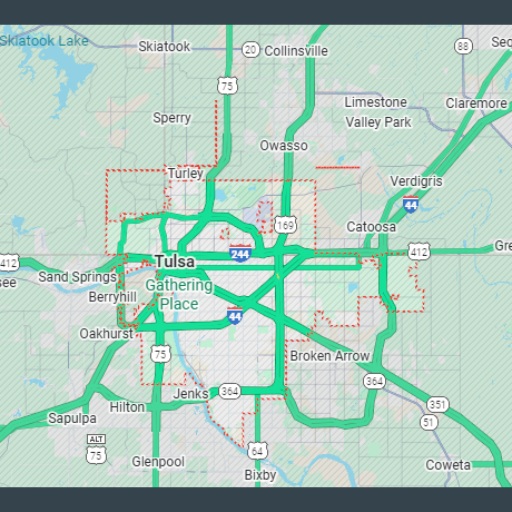
But your specific pocket, school zone perception, traffic patterns, and neighborhood reputation. Buyers buy micro-markets. Zip codes are too broad.
2. Condition and Updates
Buyers today are payment sensitive.
If rates are higher, expectations are higher. Fresh paint, flooring, lighting, roof age, HVAC age, and curb appeal all directly affect perceived value.
Condition creates leverage. Deferred maintenance reduces it.
3. Layout and Function
Square footage alone does not determine value.
Primary bedroom placement, open concept flow, natural light, storage, outdoor space usability. Buyers make emotional decisions backed by logical justification.
Layout drives emotion.
4. Pricing Strategy in the First 14 Days
This is critical.
Research consistently shows that properties receive their strongest buyer interest during the first two weeks of listing. The first two weeks on the market generate the most attention. If a home is overpriced at launch, the market does not wait to catch up. It moves on.
Strategic pricing creates multiple showings, competitive energy, and stronger negotiating position.
Overpricing creates longer days on market, price reductions, and lower net proceeds.
A Real Story From Our Market
Let me give you a real story from our market.
I listed a beautiful home in the Bixby School District. It was move-in ready. Fresh paint. Professionally staged. Clean, bright, and presented exactly how buyers want to see it.
We did everything right.
We priced it based on recent sales in that subdivision. The price per square foot aligned with the highest recent comps. On paper, it was justified.
And yet it sat. Eighty-four days.
Multiple open houses were done. Showings were steady. Feedback was positive. And yet no one wrote the offer.
Here's what that taught us.
In today's market, especially after the rapid appreciation during COVID, price per square foot is not enough. Buyers have become extremely payment sensitive. Even when a price is technically supported by data, that does not mean it matches what buyers are willing to commit to right now.
So we adjusted very strategically.
We made price improvements in $10,000 increments. We watched the activity carefully. We measured showing volume and buyer response.
And as soon as we reached the number the market was truly willing to pay, it went pending.
The home did not change. The paint did not change. The staging did not change. The marketing did not change.
Only the positioning changed.
What This Means for Pricing Strategy
That experience reinforced something important.
In this post-COVID pricing environment, determining value is more nuanced than ever. Many homeowners remember peak values. Buyers, however, are looking at today's payments, today's inventory, and today's competition.
If you are going to test the market at a higher number, that is a strategic choice. But it must come with a clear, pre-planned adjustment schedule. Small, frequent corrections protect momentum. Large, delayed reductions often cost more in the long run.
Pricing is not about being right on paper. It is about aligning with what a qualified buyer will act on.
5. Current Inventory and Demand
Is inventory tight in your neighborhood? Are buyers relocating into Tulsa? Are homes sitting or moving?
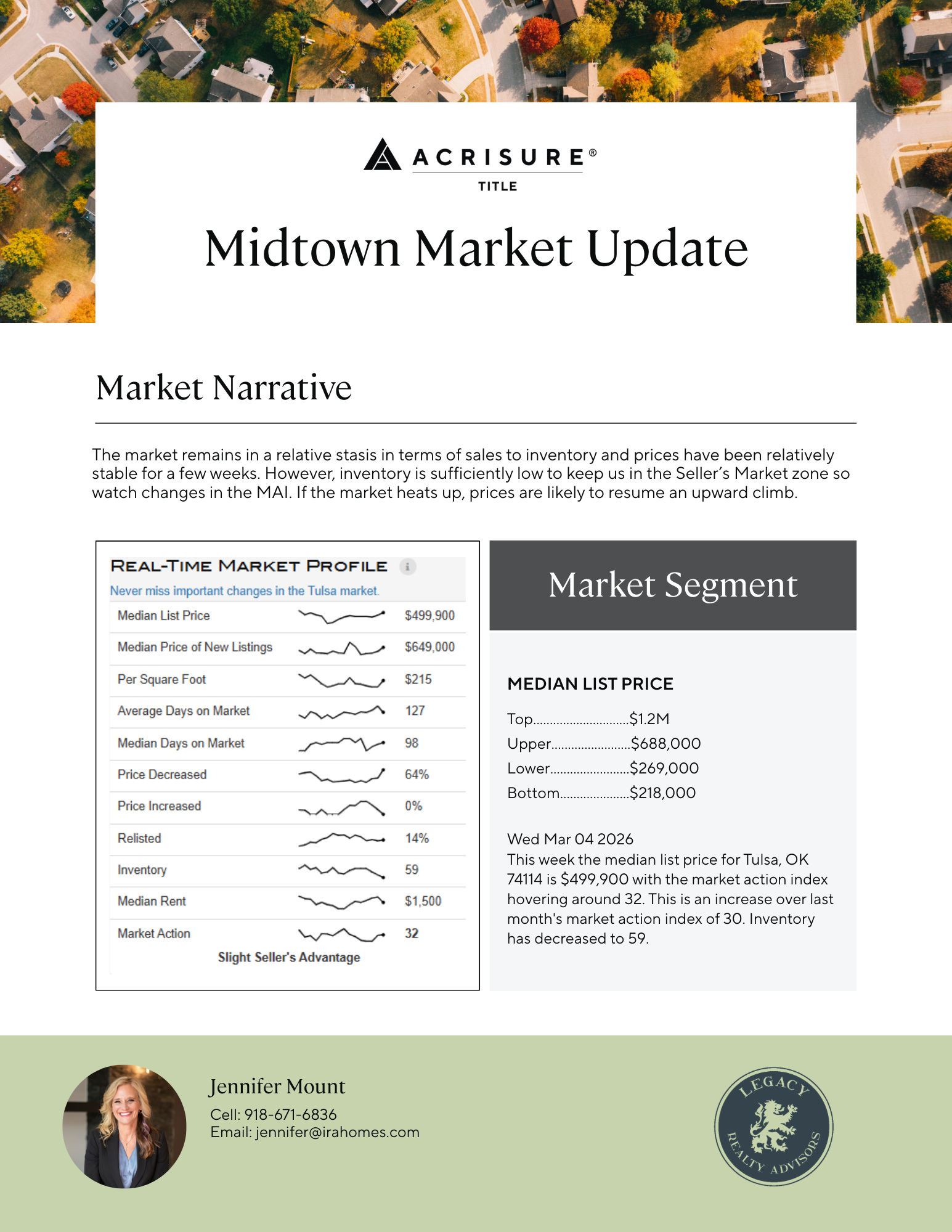
Midtown Market Update provided by www.acrisuretitle.com. | Acrisure Title of Oklahoma | Blake Burns
The Bigger Question Beneath "What Is It Worth?"
Most sellers are really asking:
If I sell, what will I walk away with? Does it make financial sense? Is this the right season for my family? Will this decision support my long-term plan?
That's where we move beyond price and into Legacy thinking.
Because selling a home touches every area of life.
Faith
Are you stewarding your equity wisely? Selling is not just a transaction. It is a strategic financial decision.
Family
Does this home still serve your season? Schools, space, proximity, lifestyle needs matter.
Finances
Your home is often your largest asset. Knowing your true equity position protects your next move.
Fitness
Uncertainty is exhausting. Clarity reduces stress. A data-backed value gives peace.
Fun
What could this equity unlock? A different neighborhood? Less maintenance? More freedom?
How We Determine True Market Value
At Legacy Realty Advisors, we do not guess.
We analyze sold properties within 0.5 to 1 mile, pending contracts, active competition, price per square foot trends, days on market, buyer behavior patterns, condition adjustments, and layout comparisons.
Then we position your home where it will attract serious buyers and generate genuine interest.
This is about maximizing net proceeds within a realistic timeframe.
Get a free market analysis for your Tulsa area home: https://lrahomes.com/selling
What Most Sellers Do Wrong
They ask three neighbors. They check Zillow. They emotionally anchor to the highest sale they have seen.
And then they price based on hope.
If You Are 30 to 90 Days From Selling
This is your window to get a true equity review, make strategic improvements, plan your timeline, understand your net sheet, and prepare mentally and financially.
The sellers who win are the ones who prepare early.
3-2-1 Takeaway
3 Things You Learned
Online estimates are starting points. Strategy requires deeper analysis. Zillow's median error rate for off-market homes is 7.01%, meaning a $500,000 home could be valued incorrectly by over $35,000.
Value is influenced by micro-location, condition, layout, and timing. Two homes on the same street can vary by $25,000 to $60,000.
The first 14 days on market are critical for maximizing price. Properties receive their strongest buyer interest during the first two weeks of listing.
2 Things to Share
Subscribe to our YouTube channel for weekly Tulsa real estate insights.
Share this blog with anyone thinking about selling their Tulsa home.
1 Thing to Do
Request a data-driven home valuation that includes condition adjustments and a strategic pricing plan. Book your consultation now.
Ready to Know Your True Market Value?
If you're even thinking about selling, let's look at the numbers together.
When you understand your true value, you can make decisions that support your faith, your family, your finances, your fitness, and your future.
That's Legacy.


