Day One Is Your Highest Price: What Tulsa Metro Sellers Need to Know Before Listing
Day One Is Your Highest Price: What Tulsa Metro Sellers Need to Know Before Listing
The first offer window on a new listing is almost always the strongest one. Buyers watching a market closely notice a new listing right away, and that early attention is where the best offers tend to come from. The longer a home sits without an accepted offer, the more that pricing power fades.
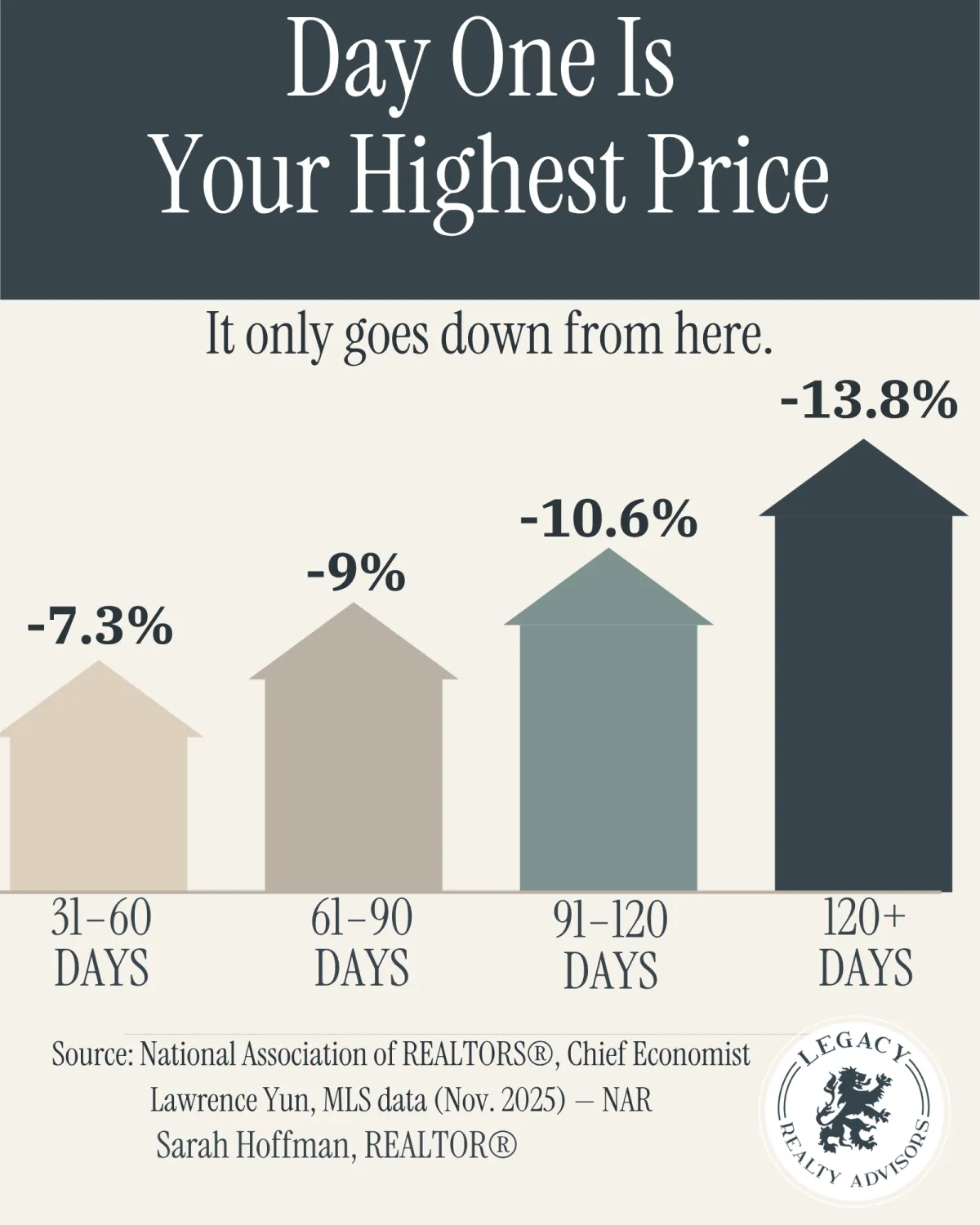
National data backs this up in a way that's hard to ignore. According to the National Association of REALTORS®, homes that sit unsold see their price reductions grow steadily the longer they stay on the market. A home still listed after 120 days sees an average price cut of nearly 14 percent, almost double the reduction seen in the first 30 to 60 days.

The Data: Average Price Reduction by Days on Market
Days on Market: Average Price Reduction
31–60 days 7.3%
61–90 days 9.0%
91–120 days 10.6%
120+ days 13.8%
Source: National Association of REALTORS®, based on MLS data reported by Chief Economist Lawrence Yun.
That pattern is steady and consistent. Every additional month a home sits unsold adds to the eventual discount a seller ends up accepting.
Why This Happens
A new listing gets the most eyes it will ever get in its first two to three weeks. Buyers and agents are watching new inventory closely, especially anything priced well for its condition and location. That early wave of attention is where multiple showings and strong offers usually come from.
Once a home has been sitting for a while, buyers start asking questions before they've even seen it.
Why hasn't this sold yet?
Is something wrong with it?
Is the seller motivated?
A stale listing carries a story, even if the real reason is simply that it launched at the wrong price. Buyers who do submit offers on an older listing also tend to negotiate harder, assuming the seller is more willing to come down.
What This Means If You're Thinking About Selling
This is national data, not a Tulsa-specific number, and local market pace can shift these figures in either direction depending on inventory, season, and price point. What doesn't change from market to market is the underlying pattern: homes priced accurately from day one sell faster and closer to asking price than homes that get chased down over several price drops.
A few things matter most going into a listing:
Price to the current market. Buyers are comparing your home to what's active right now, not what sold six months ago.
Get the home market-ready before it goes live. First showings matter more than any showing that comes after a price cut.
Use a real estate professional's pricing strategy. Avoid pricing high and "see what happens". A home priced to attract genuine interest in week one almost always outperforms one priced high "to see what happens."
If you're weighing whether to list this year, the more useful question isn't "what did my neighbor's house sell for?" it's "what would this home need to look like to get its best offer in the first three weeks?" That's a conversation worth having with an agent who can walk your specific comps with you
Frequently Asked Questions
Is this price reduction data specific to the Tulsa metro area?
No. This data comes from national MLS activity reported by the National Association of REALTORS®. Local numbers for Wagoner County, Broken Arrow, Coweta, Bixby, Jenks, or Tulsa proper can look different depending on inventory levels and buyer demand at the time. A local comparative market analysis is the best way to see how this trend applies to your specific home and area.
My home has been on the market for 60 days and hasn't sold. Should I drop the price right away?
Not necessarily, and not without a plan. Before adjusting price, it helps to look at what's changed in your local comps since you listed, how your showing activity compares to similar homes, and whether the issue is price, condition, marketing, or timing. A price cut without that context can end up being bigger than it needed to be.
Does better staging or photography offset a stale listing?
It can help attract renewed interest, but it doesn't fully solve a pricing problem. Buyers ultimately compare homes on price relative to condition and location. Strong photos and staging matter most when they're paired with a price that already makes sense for the market.
What counts as a healthy days-on-market number right now?
That depends on the local market and price point, and it changes over time. Ask your agent for the current average days on market for homes similar to yours, not a general rule of thumb, since that number moves with inventory and season.
If I relist my home, does the days-on-market count reset?
This depends on MLS rules, which can vary and change. Talk with your agent about how relisting is handled in your local MLS before making that decision, since it can affect how buyers and other agents view the listing history.
What To Do Next
If you're thinking about listing in the Tulsa metro area, the most useful first step is a real comparative market analysis, not a guess based on what a neighbor's home sold for last year. Reach out and let's look at your home's numbers together before you set a price.
Sarah Hoffman, REALTOR® Legacy Realty Advisors [email protected] | 217-972-9600 | lrahomes.com/sarah
Sources
National Association of REALTORS®, "Housing Market Set for a 2026 Comeback, NAR Predicts" — https://www.nar.realtor/news/real-estate-news/economy/housing-market-set-for-a-2026-comeback-nar-predicts
Florida Realtors, "Housing Market Set for 2026 Comeback" (reprint of NAR reporting) — https://www.floridarealtors.org/news-media/news-articles/2025/11/housing-market-set-2026-comeback